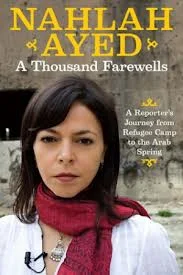
A Thousand Farewells
This week in CreComm I read the book A Thousand Farewells by Nahlah Ayed.
The book is about a Winnipeg CBC journalist who goes back to her roots in the Middle East to cover various protests and uprisings.
Ayed travels to places such as Amman, Libya, Lebanon, Jordan and Egypt. The book often switches settings which I found quite confusing because I am not familiar to specific locations in the Middle East. I wish the book included a map of the places Ayed traveled to because I often found myself looking at a map to see where exactly she was talking about.
I also found the characters difficult to keep track of as well. This is because there are so many of them and they are each in different locations. What makes the characters even more confusing is the fact that many of them have the same names or have exotic names that I found hard to remember.
(Yes I know all I have been doing so far is complaining) However, although I found some aspects of the book confusing, it could have been A LOT more confusing. For the most part, Ayed takes very complex situations and simplifies them wonderfully.
As I said earlier, I don’t know much about the Middle East or about the conflicts that are going on there; but while reading this book I understood (for the most part) what was happening. Ayed explains the factors that prompted these conflicts and why they unravelled the way they did.
But I didn’t read this book to learn about Middle Eastern history (although I’m glad I did); I read it to learn the perspective of a Winnipeg Journalist going into a foreign country and learning how she dealt with it.
Journalists can learn a great deal from this book because it has a lot of valuable advice such as…
- It’s a struggle to fit a complex story into a 30 second newscast, but you must simplify it without losing the overall message
- You have to learn when it’s appropriate to interview people and when it’s not (getting a good story to fill a newscast is not everything)
- Talk to people before you interview them to get a better sense of who they are and what their story is
- Take advantage of every situation and make the most of it whether it is positive or negative (A man jumped onto Ayed’s van to prevent the crew from traveling any further. Instead of threatening him or giving up and turning around, the crew decided to get out of the van and film him.)
The book focuses on Ayed’s journalistic career but I wish she expanded on how journalism affected her personal life (what her parents thought and how they dealt with her continuously being in a war zone) and her Canadian relationships such as friends/fellow journalists. It would have been interesting to have their perspectives as well.
If this book wasn’t assigned to my course homework, I probably would have never picked it up because I don’t usually read non-fiction. But unlike most non-fiction books, A Thousand Farewells explains events that are fairly recent and that I can remember being on the TV and radio.
Unlike most non-fiction books, I could relate to it when the settings were based in Winnipeg. This is great because she talks about places where I have been and I know exactly what she is describing.
But even though I spent hours trying to rush through it to get my other homework done and spend numerous
conversations complaining about having to read it; I’m glad I did.
While reading this book, it really clicked for me what being a journalist really means. It means listening to the stories of others and sharing them to the world. It means by being a journalist, you should always listen to your humanity and have a strong sense of apathy. I learned that no matter the situation; people are ALWAYS the story.